Description
THIS IS MY PERSONAL CHANNEL. IT IS A RANDOMISED COLLECTION OF MY VIDEOS, PICTURES AND OTHER STUFF. TUNE IN.
Showing posts with label Photo. Show all posts
Tuesday, May 22, 2012
Monday, May 7, 2012
My experience with Angelfishkeeping so far
I'm over 3 weeks into Freshwater Angelfishkeeping. And I am glad to have decided to do so.
On 15/04/2012, I started with 8 fish supposed to be marble angels, a 3 foot barebottom tank, 33% daily water changes, a DIY 1 foot composite sponge filter and thrice daily exclusive premium pellet feeds.
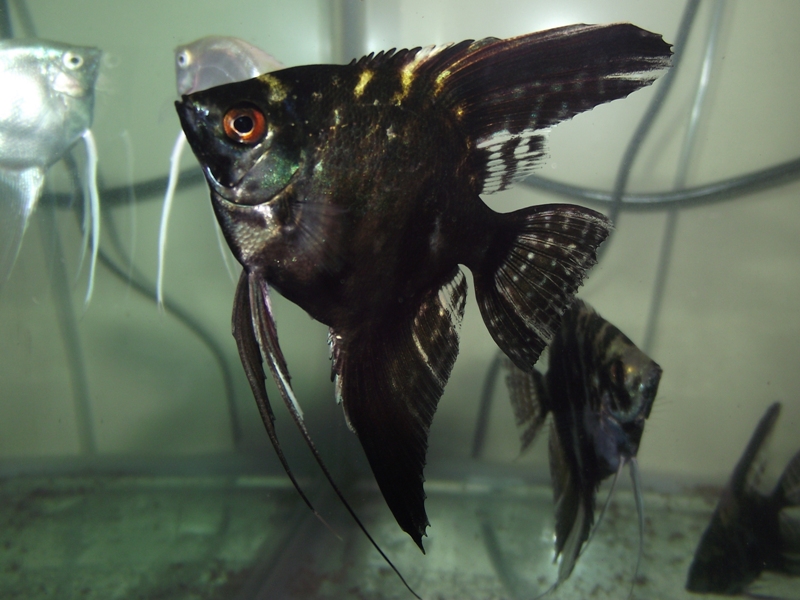
I'd codenamed my fish as Panda, Snow Leopard, Two Face, Black Marble, Batman, Grayscale, Black Stripo and Blackie.
But 3 days later, when I visited the LFS again, I fell for 2 other angels, a marble and a gold. So I got these guys in replacement for Black strippo and Blackie.
I named the marble as 'Bluefin' and the Gold as 'Rabbit Ear'.
Initially, all my angels swam together as a shoal, obviously a defensive instinct in an alien environment. They swam together and fed together. ( I love the way they feed at all levels of the tank. First, they capture food from the top, then chew it and spit it out and chew it again till it gets softened and broken down into swallowable bits. Its like two soccer players passing the ball to each other. Then they eat the sunken bits off the bottom of the tank like cattle grazing in the fields. Not even a single grain/particle is wasted. ) But as they got used to their new home, transient minor conflicts occurred over space and food. Snow Leopard was initially at the top of the pecking order. Then Rabbit Ear took over for a couple of days. Then it was Snow Leopard again. But other than feeding time, they live in harmony.
As days went by and they stabilized, they started displaying an array of colours - yellow, orange, copper, blue, green, grey, violet, peacock blue, etc. Grayscale, who had the blandest colours of the entire lot was now the most colourful. This was new for me. I always thought that marble angels are Black and White with a hint of yellow. During my study breaks, I surfed angelfish forums and consulted angelfish experts to seek more info on this. During this, I came across vast pools of information on angelfish genetics and emerging trends. Dr. Joanne Norton's articles were the most enlightening. Based on my newfound knowledge, I realised that my fish weren't merely Marble angels. They had a blend of various other genes/traits. Gold (G), Smokey (Sm) and Pinoy/Philippine/Platinum Blue (pb) were the genes responsible for the non-black&white colouration.
As the days pass by, I am learning some new things about these beautiful fish. While following the traditional rules, I am also trying some new stuff. I'll report my findings once my experiment succeeds or fails.
I'll be posting further updates only after finishing my exams in June.
Till then, enjoy these.
Birds of a feather or fish of a scale?
Panda
Snow Leopard
Two Face
Black Marble
Batman
Grayscale
Bluefin
Rabbit Ear
Saturday, May 5, 2012
Tuesday, April 17, 2012
Wednesday, April 11, 2012
ADOLF - Day 2 with the Prosthetic Swim Bladder
Adolf has been stable all day. Spent most of his time resting and cruising slowly around the tank, mostly with his tail as post haemorrhage, both his pectoral fins are inflamed, hypo-motile and showed the presence of necrosed (dead) tissue. The fin bases are now cleared off the haematoma and appear healthy and capable of generating new tissue. I debrided the dead tissue using suction-aspiration, dressed the suture wounds using a combination of methylene blue and malachite green and carried out a 80% water change. Here are some pics and vids.
Siphoning out the wastes before the suction debridement
Note the necrosed (dead) pale yellow pectoral fin tissue
Sheathed atraumatic suction tip
Right pectoral fin post-debridemant. a few haemarrhagic spots can be appreciated at the transparent base. This part is still viable. Note the cleared out and healthy looking fin-base and pectoral peduncle in contrast to the dark reddish-blue haematoma in this part seen yesterday
Skeletal remains of the left pectoral fin post-debridemant. The remaining dying tissue will be debrided tomorrow
After the debridement and dressing
Video of Adolf on Day 2 of the Swim Bladder Prosthesis Implantation, shot before the debridement, dressing & water change
Tuesday, April 10, 2012
ADOLF 7&1/2 months old - Bad times - 10/04/2012
Remember my thread on Detritus worms? It seems that there were organisms viler than detritus worms in my aquarium water. Let me take you a few weeks backwards.
Even after thoroughly cleaning my tank with potassium permanganate and rock salt, sterilizing all the filter media and treating my fish, the worms starting reappearing every week. When many of my neighbours approached me for the treatment of diarrhoea in a span of 48 hours, I grew suspicious and checked our water supply lines and was shocked to find the inlet valve compartment of my building filled with drainage water. After checking the drains, we found three compartments to be clogged up and the sewage water from these had made its way into the inlet valve compartment and through a leaky valve into the drinking water, which also happens to be the source of my aquarium water.
We got the drains cleaned up, the valves changed and the storage and loft tanks disinfected. I decided to wait for a few days before cleaning my tank, to let the chemicals pass.
I went to Bengaluru last week and then to Chennai and Pondy and thus was away for 8 days. 3 days back , my mom gave me a call regarding turbid water in the aquarium and the plecos and Adolf displaying strange behaviour. I allayed her concern and asked her to wait till I returned. I was so wrong.
I returned home yesterday evening to find a dead 14" Pleco and a lethargic Adolf, who was resting at the bottom of the tank, breathing heavily. There was a heavy milky growth on both of his pectorals and his nostrils and pectoral fin base showed obvious signs of internal bleeding. Memnoch and the other pleco seemed to be fine, except that none of them had eaten in the last 4 days. I removed the pleco, changed the water, removed the filter media and treated the water with metronidazole.
Adolf was resting at the bottom all day and began tilting by night. There was obvious involvement of his swim bladder by way of either infection or haemorrhage. Today morning, Adolf was almost upside down, but still breathing. All this time, Memnoch was by his side like a true friend. I had a sinking feeling creep over me and felt no hope for the three of us. I had some urgent business to attend to and had to leave them in this state.
I returned at noon to find Adolf upside down, but still breathing, to my relief and memnoch trying to roll him over. From my past experience, one thing was sure - my Adolf wouldn't make it. But desperate times call for desperate measures. As I had mentioned in one of my earlier posts, there was this video on you tube of a certain Red Devil with Swim Bladder disease, who was operated upon and fitted with an external prosthetic swim bladder, cut out of styrofoam for a few weeks after which, the fish recovered. I didn't know if this would help Adolf, especially at the rate at which, the infection was progressing. But antibiotic coverage was already provided and I didn't want to wait till it was too late. "Anyway the fish seems like he won't make it, so why not give it a try". With this in mind, I went ahead and with the help of TheChannaGuy, I operated upon Adolf with all aseptic precautions and fitted a styrofoam bladder to the base of his Dorsal fin. I attached an extra piece for surface floatation as of now. Is his condition improves, this piece will be removed and only the base will be in place far a couple of weeks or so till the blocked swim bladder clears up. It took a little over 7 minutes. I wasn't able to record the procedure since our hands were full. He tolerated the procedure well. Unfortunately, I have to wait till evening to conduct a water change. Lets hope that he makes it through.
Wednesday, March 14, 2012
Freshwater Detritus Worms
Yesterday, when I was cleaning my bare-bottom tank, I founds tens of thousands of tiny little white wormies colonizing my filter media. I have seen these guys on my Aquarium glass on various occasions before, especially when I had substrate in my tanks, but always thought that they were planaria.
This time though, I had a little bit of spare time and thought of viewing these under my school-time compound light microscope with a total magnification of 200x on a droplet mount. I was in for a surprise.
The weren't flatworms as I had expected, but were actually segmented roundworms with hairlike appendages and a highly functional flexible proboscis. The peristaltic motions of their viscera could be seen clearly, but I wasn't able to count the number of segments due to their continuous motion. I tried to overcome this by first placing a coverslip over the droplet mount (it bursted) and then by absorbing the water to limit its field of motion (its body shriveled up ). But both medhods failed.
One end, which appeared to be the oral end (as motion was unidirectional) sported the proboscis, while the aboral end sported a rounded bulb like structure. The microscopic anatomy of this structure wasn't clearly visible at this magnification or at this level of activity. At the junction of every two segments, there was a tuft of rigid hairlike structures emerging from both sides. These appeared to have no active role in locomotion. These guys aren't free swimmers and only slide on the bottom and sides of the aquarium like earthworms, but the motion is unidirectional. When sucked up and collected in a burette, these guys clumped and coiled up in the manner of tube-worms.
I tried to google them up on the internet, but was unsuccessful to find any images resembling them. I tried to capture their microscopic anatomy on camera, but was unsuccessful. Ultimately, I gave up and drew a rough sketch of the same. Inspite of being highly inaccurate (eg, the nodes are more widely spaced than what they appear in the sketch), hope that it helps in their ID. I gather that they must be detritus feeding annelids, but need an actual ID, to take any measures for the safety of my fish. Can the experts give an exact id or atleast a few close guesses?
Thursday, February 9, 2012
Subscribe to:
Posts (Atom)